
How to Solve Class 10 Maths NCERT Questions Step by Step
A five-step method for any Class 10 Maths question, with worked examples from quadratic equations, arithmetic progressions and trigonometry.
Imran Choudhary · · 5 min read
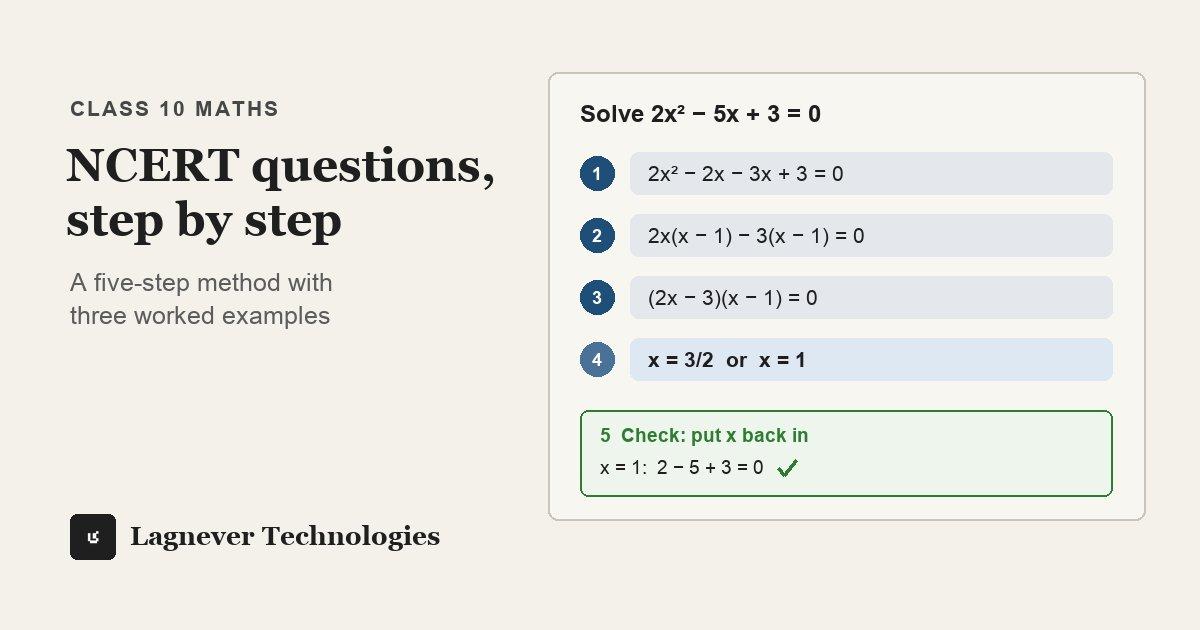
Most marks lost in Class 10 Maths are not lost because a student does not know the chapter. They are lost to a skipped step, a wrong sign or an answer that was never checked.
Board marking schemes give marks for the steps, not only for the final answer. So a clear method matters as much as knowing the formula. This article gives you one method that works for almost every NCERT question, and shows it on three chapters.
The five steps
- Read the question twice. Then write two lines: what is given, and what you have to find.
- Name the method. Before you calculate anything, decide how you will solve it: factorisation, a formula, a diagram. If you cannot name it, look at the solved examples in the same section of the chapter.
- Write one step per line. Write the formula first, then put the numbers in. Never do two operations in your head on one line.
- Check the answer. Put it back into the question. If it does not fit, the mistake is in one of your lines, and they are easy to find because each line does one thing.
- Write the final answer clearly. Box it, and add units where there are any.
Steps 1 and 4 feel slow at first. They are the two steps that save the most marks.
Example 1: a quadratic equation
Question. Solve 2x² − 5x + 3 = 0.
Given: a quadratic equation with a = 2, b = −5 and c = 3. To find: the values of x.
Method: factorisation by splitting the middle term. We need two numbers whose product is a × c = 6 and whose sum is b = −5. Those numbers are −2 and −3.
2x² − 5x + 3 = 0
2x² − 2x − 3x + 3 = 0
2x(x − 1) − 3(x − 1) = 0
(2x − 3)(x − 1) = 0
x = 3/2  or  x = 1
Check. For x = 1: 2 − 5 + 3 = 0. For x = 3/2: 2 × 9/4 − 15/2 + 3 = 9/2 − 15/2 + 6/2 = 0. Both values work.
If you cannot find the two numbers quickly, use the quadratic formula instead. Factorisation is faster when it works, and the formula always works.
Example 2: an arithmetic progression
Question. In the AP 7, 11, 15, … find the 20th term. Then find which term is 99.
Given: first term a = 7 and common difference d = 11 − 7 = 4. To find: the 20th term, and n for the term 99.
Method: the nth term formula, aₙ = a + (n − 1)d.
a₂₀ = 7 + (20 − 1) × 4
    = 7 + 76
    = 83

99 = 7 + (n − 1) × 4
92 = (n − 1) × 4
23 = n − 1
n  = 24
Check. The 24th term is 7 + 23 × 4 = 99. If n had come out as a fraction, that would mean 99 is not a term of this AP. This is a common board question, so watch for it.
Example 3: trigonometric ratios
Question. If sin A = 3/5 and A is acute, find cos A and tan A.
Given: sin A = opposite ÷ hypotenuse = 3/5. To find: cos A and tan A.
Method: draw a right triangle, find the missing side with Pythagoras, then read off the ratios.
Opposite = 3, hypotenuse = 5
Adjacent = √(5² − 3²) = √(25 − 9) = √16 = 4

cos A = adjacent ÷ hypotenuse = 4/5
tan A = opposite ÷ adjacent  = 3/4
Check. sin²A + cos²A should equal 1. Here 9/25 + 16/25 = 25/25 = 1, so the answer is consistent.
Drawing the triangle takes ten seconds and removes most of the confusion in this chapter. Do it every time, even when you think you can skip it.
Four mistakes that cost the most marks
- Losing a minus sign when a term moves to the other side. Write the move as its own line.
- Skipping the formula. If you write only the substituted numbers and make one slip, the examiner has nothing to give step marks for.
- Forgetting units in mensuration and statistics questions.
- Not reading what is asked. A question may want the sum of an AP, not its last term. Step 1 catches this.
How to practise a chapter
Work through the NCERT exercises in order, using the five steps on every question, including easy ones. The method has to become a habit before the exam, not during it. To find time for this every day, give Maths a fixed slot in your Class 10 study timetable.
Put a mark next to every question you could not solve on your own. Three days later, solve only the marked questions again without looking at the answer. The questions you get wrong a second time are the ones to ask your teacher about.
Once a week, pick ten questions from different chapters and solve them together. Mixing chapters trains you to choose the method yourself, which is what the board paper asks you to do. Science works the same way: the 30-minute chapter revision routine is built on testing yourself, not re-reading.
When you are stuck
Give a question ten honest minutes. Then read the solved example closest to it in the same section of the chapter, close the book and try again.
If you are still stuck and there is no one to ask, an app that shows the method one step at a time, such as Lagnever AI, can help. Read the steps, close the app and solve the question again on paper on your own. If you cannot do it without the app, you have not learned it yet, so mark it and come back in three days.