
How to Make a Study Timetable for Class 10 Board Exams
A simple way to build a Class 10 board exam timetable you can actually follow, with a sample weekly plan and a revision schedule.
Imran Choudhary · · 5 min read
Most timetables fail in the first week. They look good on paper, with every hour filled from 5 am to 11 pm, and then one bad day breaks the whole plan.
A timetable that works is smaller and more honest. It starts from the hours you really have, gives more time to the subjects you find hard, and leaves room for days that go wrong. This article shows how to build one in about thirty minutes.
Step 1: Count the hours you really have
Do not start with subjects. Start with your day.
Write down a normal school day from waking up to sleeping. Remove school, travel, meals, tuition and sleep. What is left is your real study time. For most students this is three to four hours on a school day and six to seven hours on a holiday.
Plan with that number, not the number you wish you had. A plan for three real hours beats a plan for eight imaginary ones.
Step 2: List every chapter, then mark each one
Take your syllabus for each subject and write down every chapter. Next to each one, put a mark:
- A if you can solve questions from it without help
- B if you understand it but make mistakes
- C if you have not studied it properly or do not understand it
This takes about fifteen minutes and it is the most useful part of the whole exercise. You will usually find that your C list is shorter than your worry about it.
Step 3: Give time by difficulty, not equally
A common mistake is giving every subject the same time. Your strong subjects do not need it.
A simple rule:
- C chapters get the most time, and they go in your best hours
- B chapters get practice questions, not re-reading
- A chapters only get quick revision
Your best hours are when your mind is freshest. For some students that is early morning, for others it is evening. Put Maths and Science numericals there. Keep reading subjects such as Social Science and languages for the hours when you are a little tired.
Step 4: Build the week
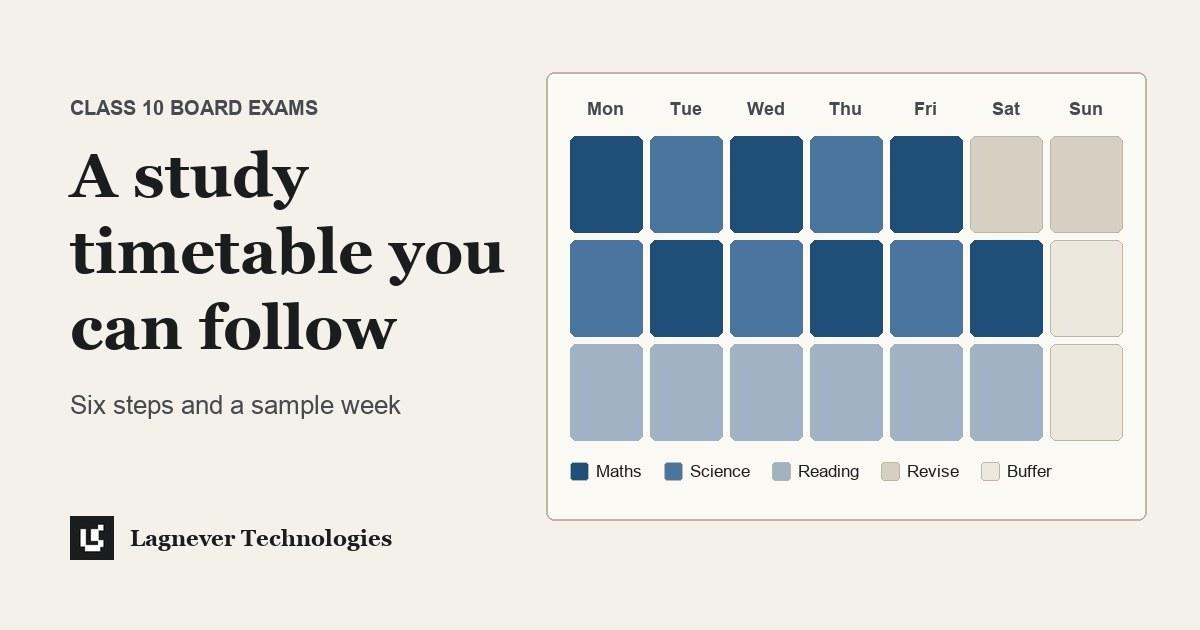
Plan one week at a time, not the whole year. Here is a sample for a school day with about three and a half hours of study.
| Time | What to do |
|---|---|
| 5:00 pm to 6:15 pm | Maths: one C or B chapter, solve questions on paper |
| 6:15 pm to 6:30 pm | Break, away from the phone |
| 6:30 pm to 7:30 pm | Science: one topic, with diagrams and numericals |
| 7:30 pm to 8:30 pm | Dinner and rest |
| 8:30 pm to 9:15 pm | Social Science or a language: read and make short notes |
| 9:15 pm to 9:45 pm | Revise what you studied yesterday |
And a sample for the week:
| Day | Main subject | Second subject | Reading subject |
|---|---|---|---|
| Monday | Maths | Science (Physics) | English |
| Tuesday | Science (Chemistry) | Maths | Social Science (History) |
| Wednesday | Maths | Science (Biology) | Hindi or second language |
| Thursday | Science (Physics) | Maths | Social Science (Geography) |
| Friday | Maths | Science (Chemistry) | English |
| Saturday | Weak chapters from the week | One sample paper section | Social Science (Civics, Economics) |
| Sunday | Weekly revision and a timed test | Catch up on anything missed | Rest in the evening |
Change the subjects to match your own A, B and C list. The shape matters more than the exact order: Maths on most days, Science split by part, one reading subject daily, and one day kept for catching up.
Step 5: Put revision inside the timetable
Reading a chapter once is not enough. You forget most of what you read within a few days unless you come back to it.
A simple schedule that works:
- Revise a chapter the next day for ten minutes
- Revise it again after one week
- Revise it once more after one month
When you revise, close the book and try to write or say the main points from memory first. Then check what you missed. This is harder than re-reading, and that is why it works better. Here is a full 30-minute routine to revise a Science chapter this way.
Step 6: Keep one buffer slot
Something will always go wrong. A school function, a fever, a family visit.
Keep one empty slot in the week, such as Sunday afternoon. If the week went well, use it for a sample paper. If it did not, use it to catch up. Without a buffer, one missed day makes the whole timetable feel broken, and that is when most students stop following it.
Mistakes to avoid
- Planning every minute. Leave gaps. A timetable is a guide.
- Only reading, never writing. Board exams test what you can write in limited time. Solve on paper, one step per line.
- Leaving sample papers for the last month. Start with single sections early, then move to full papers.
- Cutting sleep. A tired mind forgets faster. Keep seven to eight hours.
- Copying a topper's timetable. Their weak subjects and free hours are different from yours.
When you get stuck on a question
A timetable also breaks when one doubt eats an hour. Set a limit: if you cannot move forward in ten minutes, mark the question and get help, from a teacher, a friend or a tool.
This is one of the reasons we built Lagnever AI. You can type or photograph a question and it explains the method step by step, so you understand where you got stuck and can try the next question yourself.
A quick checklist
- I counted my real study hours
- I marked every chapter A, B or C
- My hardest subject is in my best hours
- Revision is written into the plan
- I have one buffer slot every week
- I will review the plan every Sunday and change what did not work
Start with one week. Follow it, see what broke, and fix that part for the next week. By the third week you will have a timetable that fits you, and that is the one you will keep following until the exam.