
How to Revise a Science Chapter in 30 Minutes
A 30-minute routine for revising any Class 10 Science chapter, worked through on Chemical Reactions and Equations.
Imran Choudhary · · 5 min read
Reading a chapter again feels like revision, but most of it is recognition. You see a line, you think "I know this", and you move on. In the exam there is no line to recognise. You have to produce the answer from memory.
Learning research has found the same thing many times: testing yourself works better than reading again. This routine is built around that. It takes thirty minutes, works for any Science chapter, and leaves you with a short list of exactly what you still need to learn.
The routine
| Time | Step | What you do |
|---|---|---|
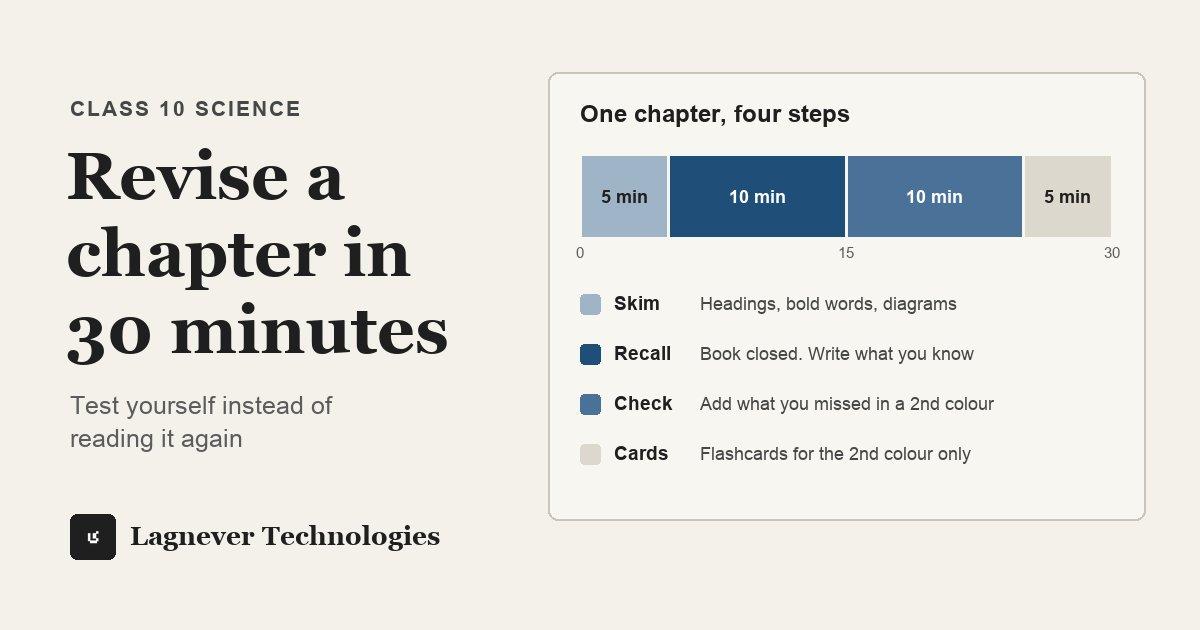
| 0 to 5 min | Skim | Read only the headings, bold words, diagrams and in-text questions. Write the main headings on a blank page. |
| 5 to 15 min | Recall | Close the book. Under each heading, write everything you remember: definitions, equations, diagrams. Do not look. |
| 15 to 25 min | Check | Open the book. In a different coloured pen, add what you missed and correct what was wrong. Then answer three exercise questions. |
| 25 to 30 min | Flashcards | Make flashcards only for what is in the second colour. |
The second colour is the point of the whole exercise. Everything in that colour is something you thought you knew and did not. That is your revision list for this chapter, and it is usually much shorter than the chapter.
Worked example: Chemical Reactions and Equations
Skim (5 minutes). The headings on your blank page would be: chemical equations and balancing, types of chemical reactions, oxidation and reduction, and the effects of oxidation in daily life.
Recall (10 minutes). Under "types of chemical reactions", try to write each type with one example equation. A complete answer looks like this:
| Type | What happens | Example |
|---|---|---|
| Combination | Two or more substances form one product | 2Mg + O₂ → 2MgO |
| Decomposition | One substance breaks into simpler ones | CaCO₃ → CaO + CO₂, on heating |
| Displacement | A more reactive element replaces a less reactive one | Fe + CuSO₄ → FeSO₄ + Cu |
| Double displacement | Two compounds exchange ions | Na₂SO₄ + BaCl₂ → BaSO₄ + 2NaCl |
| Redox | One substance is oxidised and another is reduced | CuO + H₂ → Cu + H₂O, on heating |
Write what you can before you compare. If you remembered the types but not the equations, that is useful to know.
Check (10 minutes). Most students find the same gaps here: the balanced form of an equation, the colour changes, and the difference between corrosion and rancidity. Add these in your second colour. Then answer three questions from the end of the chapter, choosing at least one you find hard.
Flashcards (5 minutes). Turn each second-colour item into a question on one side and a short answer on the other. For example:
- Front: What is rancidity, and how is it prevented? Back: Fats and oils in food get oxidised, which changes their smell and taste. It is slowed by adding antioxidants, keeping food in airtight containers, or filling chip packets with nitrogen.
- Front: Why does a blue copper sulphate solution fade when an iron nail is dipped in it? Back: Iron displaces copper. Iron sulphate forms, which is pale green, and brown copper coats the nail.
Write the answer in your own words, not copied from the book. If you cannot put it in your own words, you do not understand it yet, and that is worth knowing too.
Changing it for Physics and Biology
- Physics: in the recall step, write every formula with its units and what each letter stands for. In the check step, solve two numericals instead of three theory questions, writing one step per line as in this method for Class 10 Maths questions.
- Biology: in the recall step, draw the diagrams from memory and label them. Labelled diagrams carry marks, and they are what students most often forget.
Coming back to the chapter
Thirty minutes once is not enough for a board exam. What helps is coming back briefly at growing gaps: go through the flashcards the next day, again after three days, and again after a week. Each round takes about five minutes. Write these rounds into your weekly study timetable so they do not get skipped.
Put the cards you get right in one pile and the ones you get wrong in another. Only the wrong pile needs the next round.
Three ways the routine goes wrong
- Peeking during recall. The moment you open the book, the routine becomes reading again. Struggling to remember is what makes the memory stronger.
- Highlighting instead of writing. Highlighting the book feels active, but nothing has to come out of your memory. Write.
- Phone on the desk. Thirty focused minutes beats an hour with notifications. Keep the phone in another room, or use it only for the timer.
Where an app fits
An app such as Lagnever AI can write a short summary of a chapter or turn your notes into flashcards, and that can save time in the last two steps. Do the recall step on paper, yourself, every time. That is the step that does the learning.
Try the routine today with the chapter you are least confident about. Your second-colour list will tell you exactly where to spend the rest of the week.